How Hot Does a Deep Fryer Get?
A home deep fryer usually reaches 375°F to 390°F at its highest setting. The common frying range is 325°F to 375°F, and oil pushed past about 400°F starts to break down and smoke.
On this page (8 sections)
- How hot does a deep fryer get at its top setting?
- What oil temperature should you actually fry at?
- What happens to oil above 375°F?
- Why does the temperature drop when food goes in?
- How do you measure the real oil temperature?
- What should you do if the fryer overheats or the oil catches fire?
- Which fryers hold high heat best?
- What's the short answer on deep fryer heat?
A home deep fryer usually reaches 375°F to 390°F at its highest setting. The common frying range is 325°F to 375°F, and oil pushed past about 400°F starts to break down and smoke.
So when you ask how hot does a deep fryer get, the honest answer is: hot enough to crisp food fast, not hot enough to be safe left alone. That ceiling is not a limitation.
It is the design. Home fryers stop below the smoke point of most cooking oils on purpose, because hotter oil degrades quickly and turns a routine batch of fries into a grease fire risk.
How hot does a deep fryer get at its top setting?
Most countertop models top out at 375°F to 390°F. The dial or digital panel simply stops there.
A few restaurant-style units reach 400°F, but the ones sold for home kitchens rarely do.
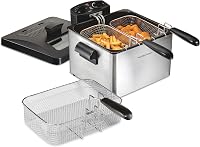
The Hamilton Beach 4.5 L is a good example of how makers set the range. Its adjustable dial runs from 265°F to 375°F, and a ready light tells you when the oil hits the set point.
That top end of 375°F covers nearly everything you'd fry at home. The range also runs well below the smoke point of common oils, which leaves room for the oil to handle a few batches without degrading.
Temperature is measured at the heating element or the oil near it, not across the whole pot. The oil closest to the element runs hotter than the oil at the surface, which is why stirring or letting the fryer settle matters.
It's also why a clip-on thermometer can read a little different from the dial. That gap widens in a full pot, where the oil near the food sits cooler than the oil against the 1800-watt element.
What oil temperature should you actually fry at?
Fry most foods between 350°F and 375°F. That band gives you a crisp crust without scorching the outside before the inside cooks.
Different foods want different spots in that range.
| Food | Target oil temperature |
|---|---|
| Thick cut fries (first fry) | 325°F |
| Thick cut fries (second fry) | 375°F |
| Raw chicken pieces | 350°F to 365°F |
| Fish fillets | 350°F to 360°F |
| Doughnuts and fritters | 350°F to 365°F |
| Thin shoestring fries | 365°F to 375°F |
Lower heat suits thicker, denser food because it needs time to cook through. Higher heat suits thin pieces that cook in a minute or two.
Going below about 325°F is the bigger mistake: the crust soaks up oil and turns greasy before it browns.
The Presto Pro Fry's adjustable thermostat lets you pick a temperature for each batch. Its signal light tells you when the oil is ready, so you're not guessing from bubbles alone.
That signal matters most on the lower settings, where oil takes longer to heat and a glance at bubbles can mislead you into adding food too soon.
What happens to oil above 375°F?
Oil starts to break down faster once it passes 375°F. It smokes, darkens, and picks up off flavors.
Repeated batches at the top of the range shorten its useful life.
Every oil has a smoke point, the temperature where it visibly smokes. Refined vegetable, canola, and peanut oils sit well above 400°F.
That margin is thin, though, and it shrinks each time you reuse the oil. Old oil smokes at a lower temperature than fresh oil.
Heat is also cumulative: a fryer cycled up and down near its top setting all evening works the oil harder than one used for a single batch at 350°F.
Signs your oil is too hot or worn out include a bluish haze, a sharp burnt smell, and foam that doesn't settle. Let the oil cool fully, then replace it.
Our guide to how to clean a deep fryer covers filtering and changing oil so it lasts longer.
Why does the temperature drop when food goes in?
Cold food pulls heat out of the oil immediately. A big batch can drop the oil by 25°F to 50°F in seconds.
The fryer then works to climb back to the set point.
This is called temperature recovery, and wattage drives it. An 1800-watt element like the one in the Hamilton Beach 4.5 L reheats faster than a lower-power model.
More oil in the pot also holds heat steadier, so a large fryer absorbs a batch better than a small one. A big pot has more thermal mass to spread the cold shock across, while a small pot feels every handful of frozen fries.
Three habits keep the oil near target:
- Let the ready light come back on between batches.
- Fry in smaller loads rather than filling the basket.
- Pat food dry and let it sit a minute before it goes in.
Wet batter and frozen food are the worst offenders. Shake off excess ice and drain wet coatings so the oil doesn't spend its heat boiling off water.
If you're new to the appliance, how to use a deep fryer walks through preheating and batch sizes.
How do you measure the real oil temperature?
Use a clip-on thermometer for the truest reading. A dial can drift, and the element runs hotter than the oil around your food.
A separate probe tells you what the food actually sees.
Clip a candy or deep-fry thermometer to the side of the pot, with the tip in the oil but not touching the element or basket. Give it a minute to settle after you stir.
Compare it to the dial and note the gap so you can adjust next time. Some fryers skip a temperature dial entirely and offer presets or a single on setting.
In that case the thermometer does more of the work.
Keep the tip clear of the basket so it doesn't snag when you lift food out. Never leave a thermometer in while the basket goes in and out.
It can catch on the wire or tip into the hot oil. Take the reading, then set the thermometer aside on a heatproof rest before you lower the basket.
What should you do if the fryer overheats or the oil catches fire?
Cut the power first and smother the fire; never throw water on it. Water turns to steam instantly in hot oil and throws burning grease into the air.
For an overheat with no fire, unplug the fryer and let it cool completely before touching anything.
For a fire in the pot, unplug it if you can reach the cord safely, then cover the pot with a metal lid or use a Class K extinguisher. Then get out and call for help if it grows.
The Ougist Class K extinguisher is made for kitchen grease fires. Its 1-A:K rating covers cooking oil and ordinary combustibles, and the 34 fl oz wet chemical agent is sized for a home kitchen.
At 4.4 ounces it is light enough to grab one-handed in a hurry.
Keep it within reach of the fryer but away from the cooking zone itself, so flames don't block your path to it. Read the label and know the pull-aim-squeeze-sweep steps before you ever need them.
Our deep fryer safety tips cover placement, cords, and kids around hot oil.
Which fryers hold high heat best?
Fryers with more watts and a larger oil volume hold temperature best. They recover faster after a cold batch and keep the oil steadier across several rounds.
That matters most if you fry for a family rather than one snack.
The Hamilton Beach 4.5 L Professional Style Deep Fryer combines a 19-cup oil capacity with an 1800-watt immersed element. Its dial runs 265°F to 375°F and the ready light confirms the set point.
Three baskets let you fry two foods at once.
The Presto Pro Fry pairs an 1800-watt immersion element with an adjustable thermostat and a signal light. Its enameled pot holds up to 5 quarts of oil.
The spatter shield helps keep hot oil where it belongs while you cook.
If you're weighing pot size against recovery speed, how much oil does a deep fryer use breaks down capacity and what it means for batch size. Match the fryer to how much food you cook at once, not just to the top temperature on the box.
What's the short answer on deep fryer heat?
A deep fryer gets hot enough to fry at 350°F to 375°F, and most stop at 375°F to 390°F. That's the sweet spot for crisp food and reasonable oil life.
Pushing past 400°F trades safety and oil quality for very little gain.
Pick a fryer with enough watts and oil volume to hold its temperature, and use a separate thermometer when you want certainty. Keep oil below its smoke point, never leave a heating fryer unattended, and keep a Class K extinguisher close by.
Cook within those limits and your fryer stays both hot and safe.
Frequently asked questions
Is 400°F too hot for deep frying?
Yes, for normal home frying. Oil starts to smoke and degrade around 400°F depending on its smoke point.
Stay at 375°F or below unless a recipe gives you a specific reason to go higher.
Why does my deep fryer drop in temperature when I add food?
Cold food pulls heat out of the oil in a rush. A fryer with more watts and more oil recovers faster.
Fry in smaller batches and let the ready light cycle back on before the next load.
Can a deep fryer reach the smoke point of oil?
Some can, if you leave them on high with little or no food inside. That's why you should never walk away from a heating fryer.
Unplug it at the first sign of steady smoke or a burnt smell.
What temperature should I fry chicken at?
Fry raw chicken at 350°F to 365°F so the inside cooks through before the crust burns. Dark meat and bone-in pieces do better near the lower end, while thin cutlets can go toward 365°F.